A bakery is a manufacturer and a distributor operating under the same roof. Every morning starts with a production decision: what to bake, how much, and in what order. That decision depends on standing orders from route customers, walk-in demand, and whatever the sales team committed to yesterday. The ingredients that go into each batch have their own shelf lives, their own lot numbers, and their own supplier histories. The finished product has an expiration clock that starts the moment it comes out of the oven. And by the time the sun comes up, cases need to be loaded onto trucks in the right order for drivers who are already running behind.
Most ERP systems were not designed for this. They handle distribution or manufacturing, rarely both, and almost never in the compressed timeframes that bakeries operate in. A bakery does not have the luxury of a three-day production planning cycle. Decisions are made daily, often before dawn, and the consequences of getting them wrong show up as waste, shorts, and unhappy customers before lunch.
Ask the Ledger is bakery ERP software built for exactly this kind of operation. It connects recipe management, production planning, inventory control, order processing, route logistics, and invoicing in a single system so that the person deciding what to bake in the morning and the person loading the truck two hours later are working from the same data.
What makes bakeries different
Bakeries face a combination of challenges that no single-purpose software handles well. The production side needs recipe management with ingredient tracking, batch sizing, and yield calculations. The distribution side needs route planning, recurring order management, and high-volume invoicing. The compliance side needs lot traceability that can survive a health department audit. And all three sides need to work together without manual bridges, spreadsheet reconciliation, or duplicate data entry.
- Recipes are the backbone. Every product starts with a bill of materials. A rye bread is not just a SKU with a price. It is a specific combination of flour, water, yeast, caraway, and salt in defined quantities with a defined yield. The system that manages inventory must understand this relationship so that when you plan to bake 200 loaves, it can tell you whether you have enough flour before you start mixing, not after you run out.
- Ingredients expire. Flour received last Tuesday and flour received today are not interchangeable if one expires next week. FEFO (first expiry, first out) is not a warehouse preference. It is a food safety requirement. The ERP must enforce it during production, not just track it in a report.
- Lot traceability is a regulatory obligation. When a flour supplier issues a recall, the bakery must identify every batch that used that flour, every finished product that came from those batches, and every customer who received those products. This trace must be completable in minutes, not hours. Auditors do not accept "we will get back to you."
- Production volume is demand-driven and daily. Bakeries do not build to stock in the way a widget manufacturer does. Tomorrow's bake is driven by tomorrow's route orders, standing orders, and expected walk-in demand. The planning horizon is measured in hours, and overbaking is waste while underbaking is lost revenue.
- Delivery is part of the product. Most bakery customers expect delivery on a schedule. Route trucks run daily or multiple times per week. The bakery needs to know what each route requires, aggregate that demand into a production plan, and then reverse the process to load trucks in stop order. This is not a shipping afterthought. It is the core workflow.
Want to see this with your own data?
Schedule Your Live DemoRecipe management and BOM control
Every bakery product in the system is backed by a bill of materials that defines exactly what goes into it. The recipe stores ingredient quantities per batch, expected yield, scrap percentages, production notes, packaging instructions, allergen flags, and shelf life in days. When a production order is created, the system explodes the recipe to calculate exactly how much of each ingredient is needed, accounting for waste and yield ratios.
Recipes are versioned, so when the head baker adjusts a formula, the old version is preserved for cost comparison and audit purposes. Sub-recipes are supported for operations that use pre-mixes or dough bases that feed into multiple finished products. The allergen flags on each recipe flow through to production documentation, so operators know which lines require allergen cleaning protocols without checking a separate reference.
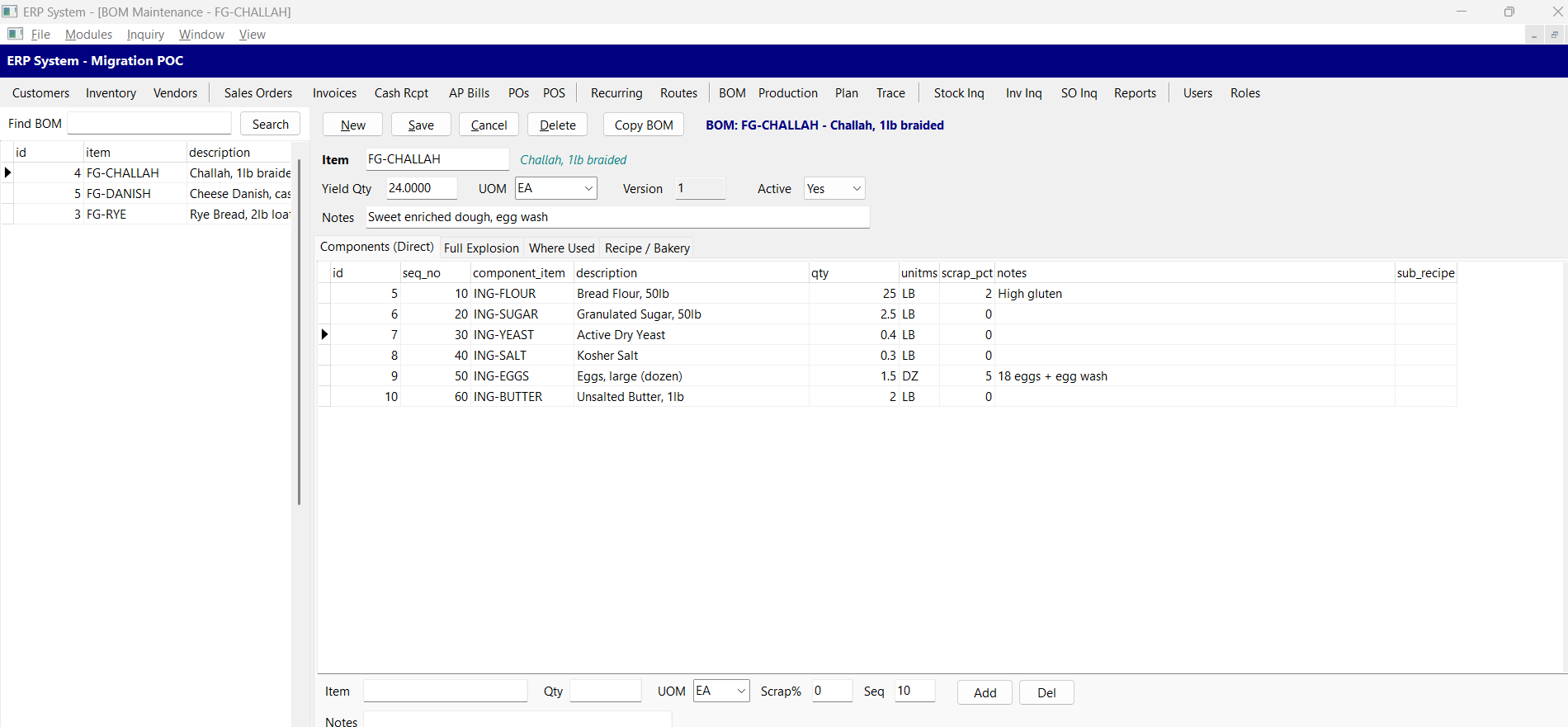
BOM / Recipe Maintenance with bakery-specific fields
Production planning
The production planning screen aggregates demand from three sources: open sales orders, recurring billing templates, and manual adjustments. For a given production date, the system shows what needs to be baked, how much of each ingredient that requires, and where shortages exist before a single mixer is turned on.
The planner sees four views on one screen. The demand tab shows finished goods quantities by item and source. The ingredient requirements tab shows the exploded material needs with current on-hand quantities. The shortages tab highlights any ingredient where on-hand stock falls short of what the plan requires. And the planned orders tab shows production orders that have already been created for that date.
Creating production orders from the plan is a single click. The system generates one manufacturing order per finished product, pre-populated with the correct ingredient list and quantities from the recipe. No re-keying. No spreadsheet. The planner reviews, adjusts if needed, and releases to the floor.
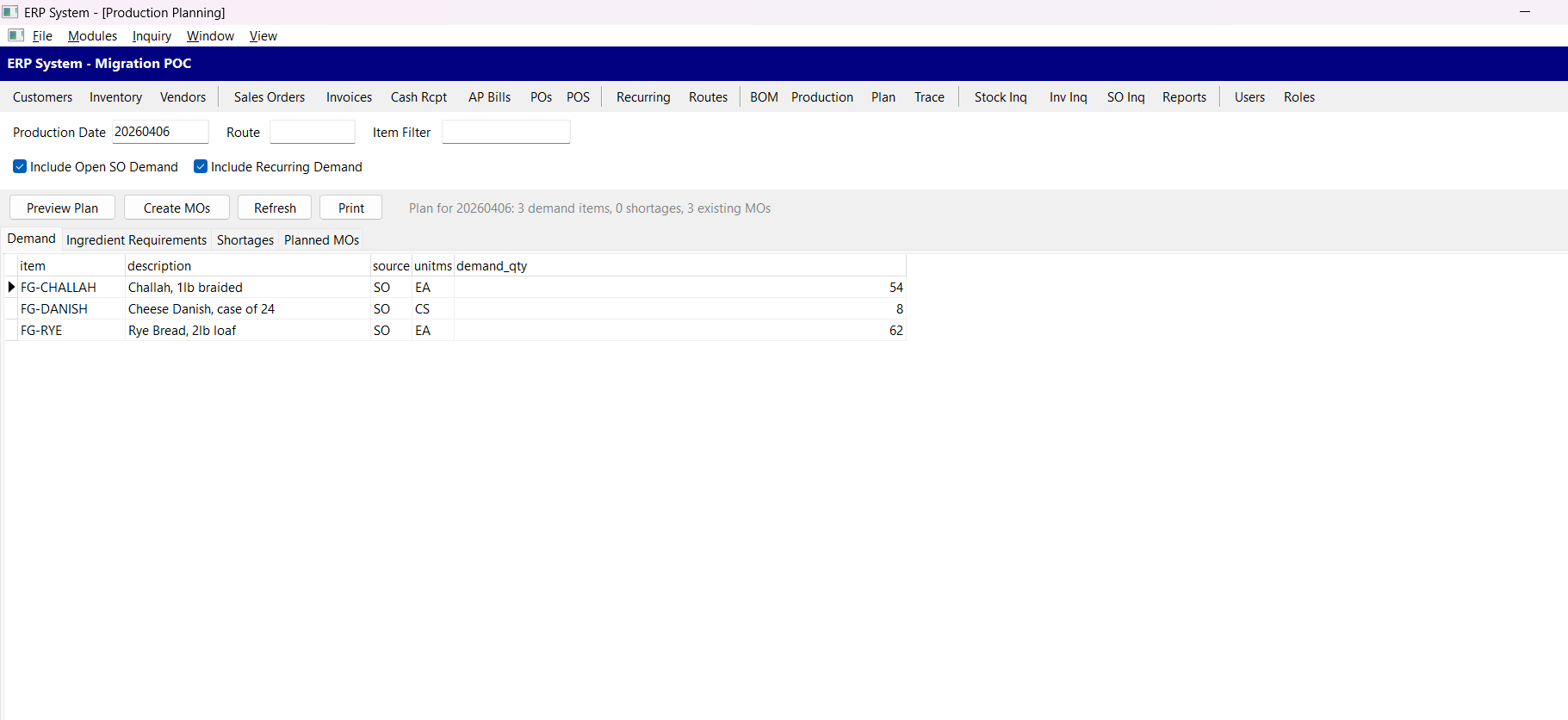
Production Plan: aggregated demand by finished goods item
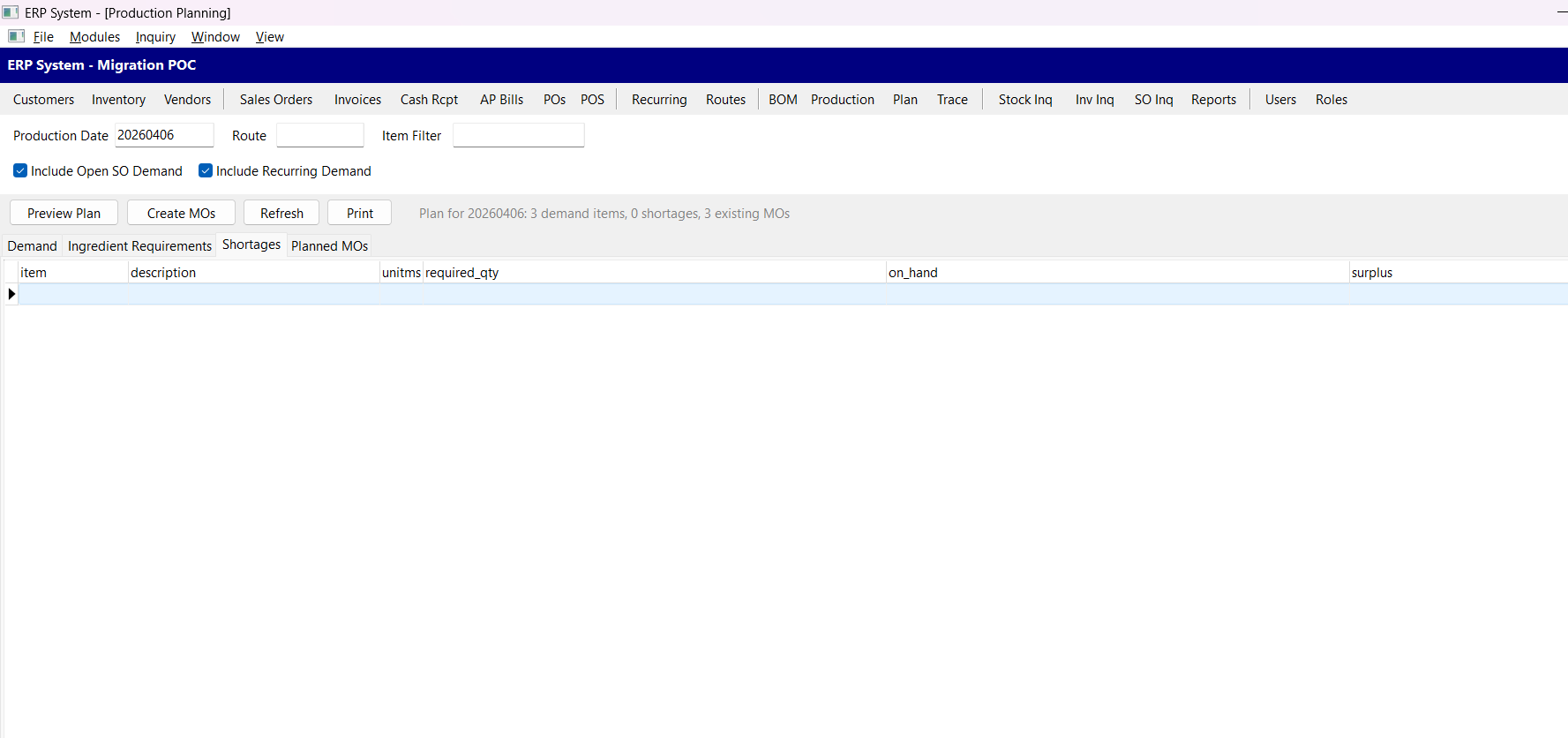
Ingredient shortages surfaced before production starts
Shop-floor status board
Once production orders are released to the floor, a bakery manager needs to see at a glance where everything is. Who's mixing? What's in the oven? Which pans are cooling? What's already packed and ready for route dispatch? The Production Status Board is a kanban-style monitor with customizable stages — receiving, mixing, proofing, baking, cooling, packaging, staging for delivery — that runs maximized on a shop-floor display. Columns per stage, cards per manufacturing order, auto-refresh every 30 seconds. Right-click a card to move it to the next stage and the system logs the transition with user and timestamp. Double-click opens the underlying manufacturing order.
The stage list itself is data, not code — you add, remove, rename, and color-code stages in a setup screen to match your actual workflow. A scratch bagel operation and a packaged-goods wholesale bakery use different stage sets; both use the same board. The underlying audit log (what moved through which stage, when, by whom) supports later production-time analysis and bottleneck diagnosis.
Lot tracking and FEFO enforcement
Every ingredient that enters the bakery can be tracked by lot number, received date, expiration date, and supplier. When a production order is executed, the system suggests which lot to pull for each ingredient using FEFO logic: earliest expiry first, earliest receipt date as a tiebreaker, lot number as a final deterministic sort. The operator confirms or overrides the suggestion.
The system blocks completion of a production order if a required lot is expired, recalled, or has insufficient quantity on hand. This is not a warning that can be dismissed. It is a hard stop. The finished goods lot that comes out of production inherits a lot number and an expiration date calculated from the recipe's shelf life setting, creating a complete chain from raw ingredient to finished product.
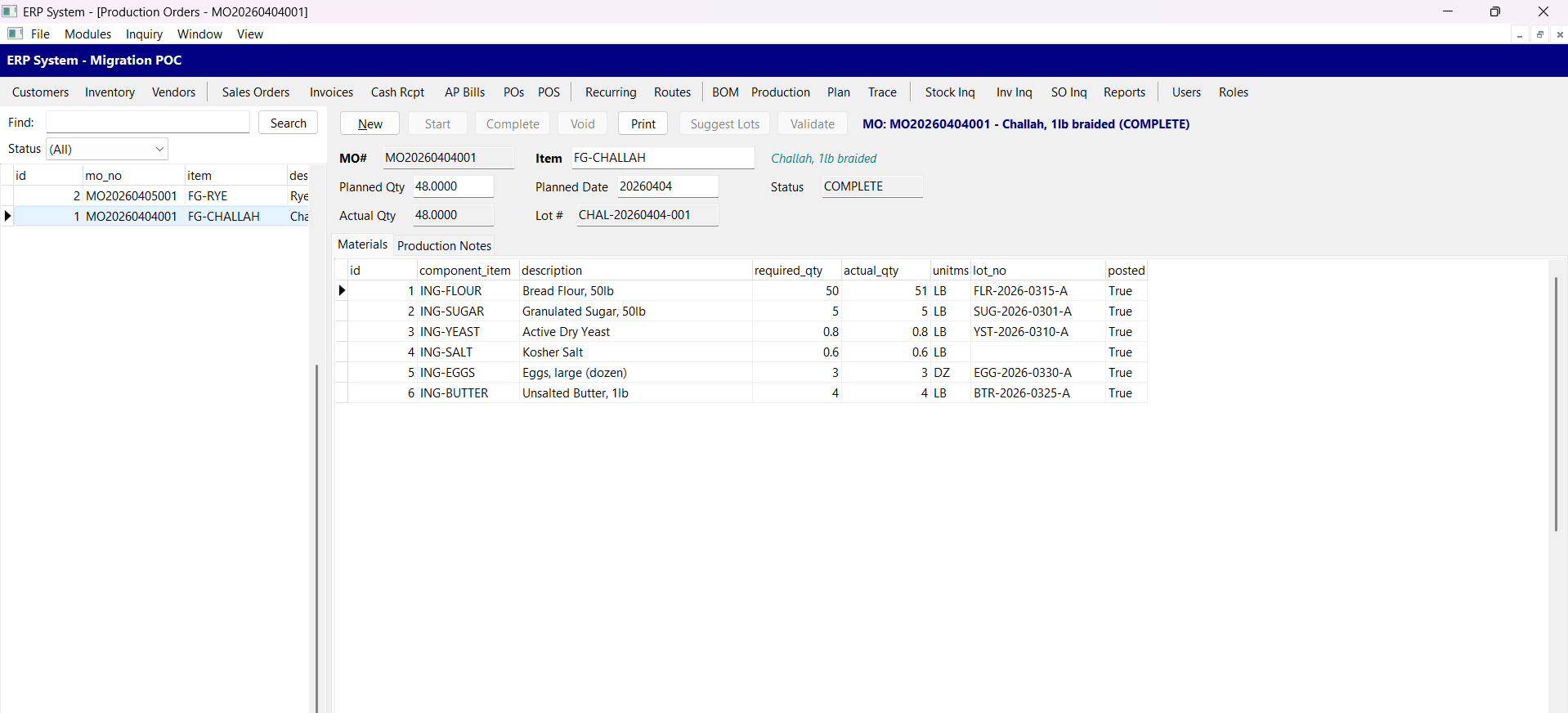
Production Order with FEFO lot assignments and validation
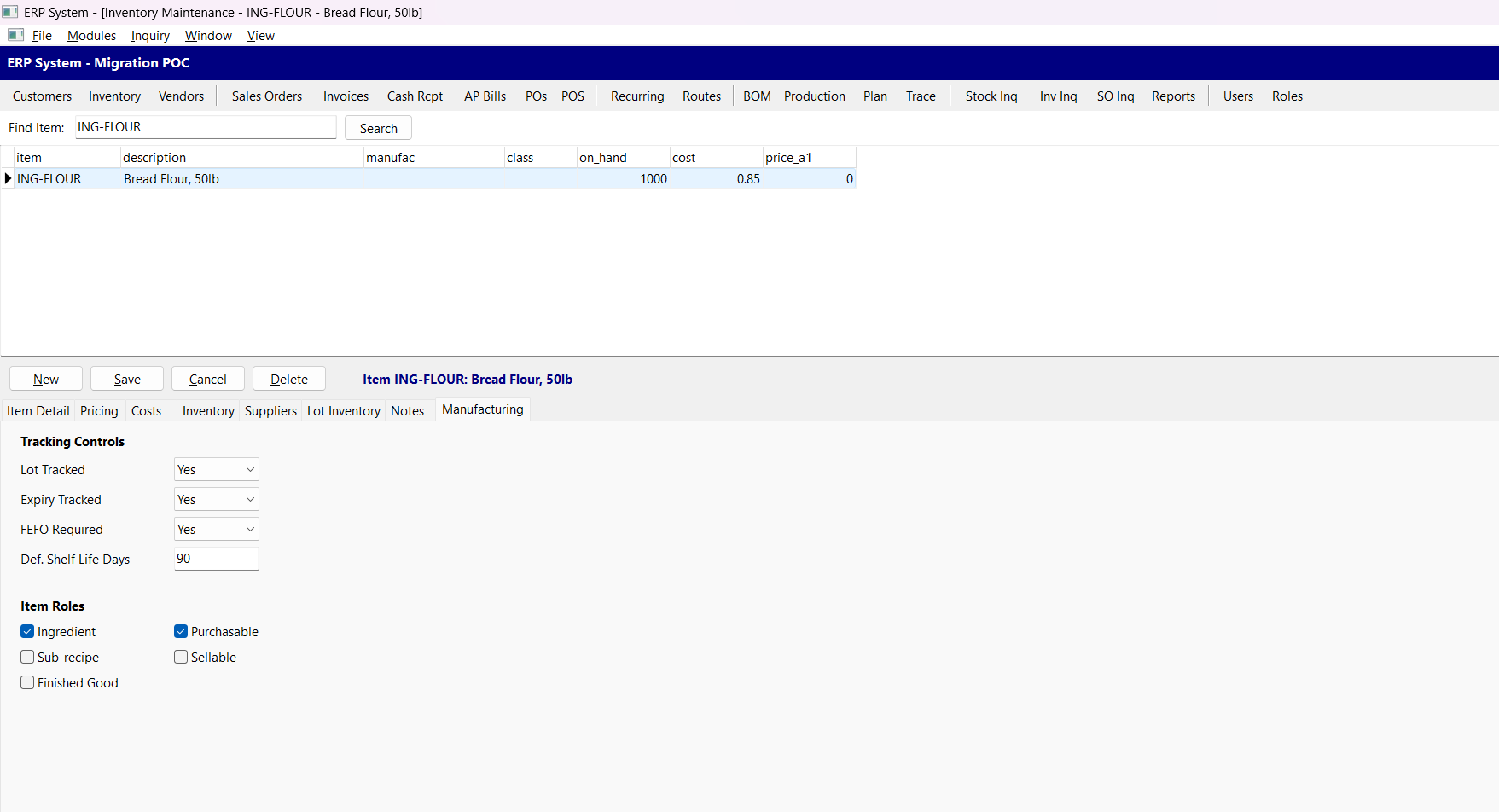
Item-level manufacturing flags
Production costing
Every completed production order captures both standard and actual material costs. The standard cost is calculated from the recipe quantities at the time of completion. The actual cost reflects what was really consumed, using the best available cost data: the lot's receipt cost if available, the item's average cost as a fallback, or the standard cost as a last resort. These costs are frozen at completion time so that historical variance analysis remains stable even as ingredient prices change.
Three reports support production economics. The production variance report compares planned versus actual quantities and costs across completed orders. The batch cost report shows cost per finished unit for each production run. And the expiring lots report surfaces inventory that needs to be used or written off before it expires, sorted by urgency.
Recall readiness
Recall readiness is not a feature bakeries hope to never use. It is an operational requirement that auditors verify. Ask the Ledger provides full forward and backward traceability through the production chain.
Forward trace starts with an ingredient lot and shows every production order that consumed it, every finished lot that resulted, and every customer shipment that carried those finished lots. Backward trace starts with a finished lot and works in reverse to identify every ingredient lot that went into it.
When a recall event occurs, the system generates a recall packet: a single document that contains the trigger lot information, an impact summary showing how many production orders and finished lots are affected, a table of affected finished lots with on-hand quantities, and a customer impact section showing exactly which customers received product from the affected batches with shipment dates and quantities. This packet is designed to be handed directly to a health department auditor.
Beyond documentation, the system supports containment actions. The trigger lot can be marked as recalled, which immediately blocks it from future use in production. All downstream finished lots can be placed on hold with a single click, preventing them from being shipped until the situation is resolved.
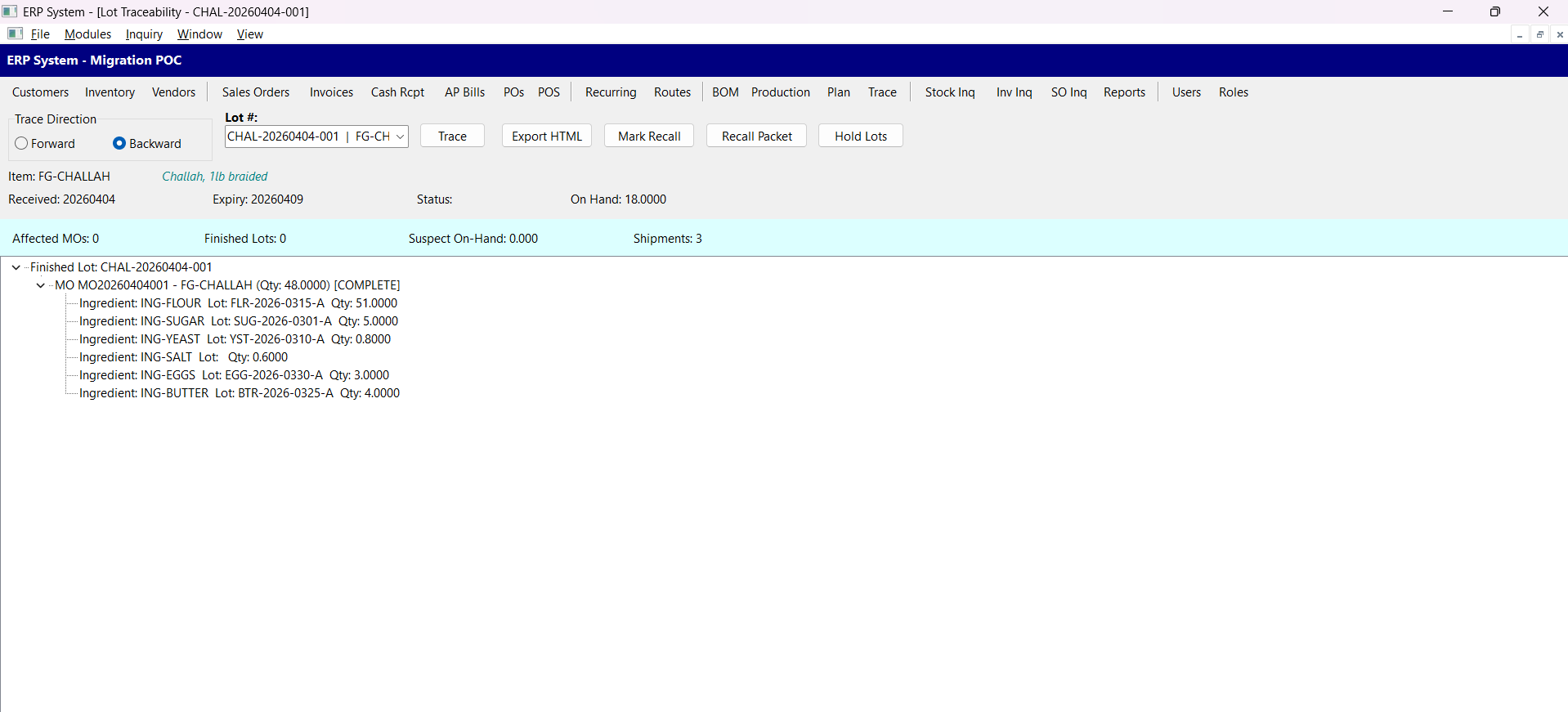
Forward and backward lot trace with recall summary
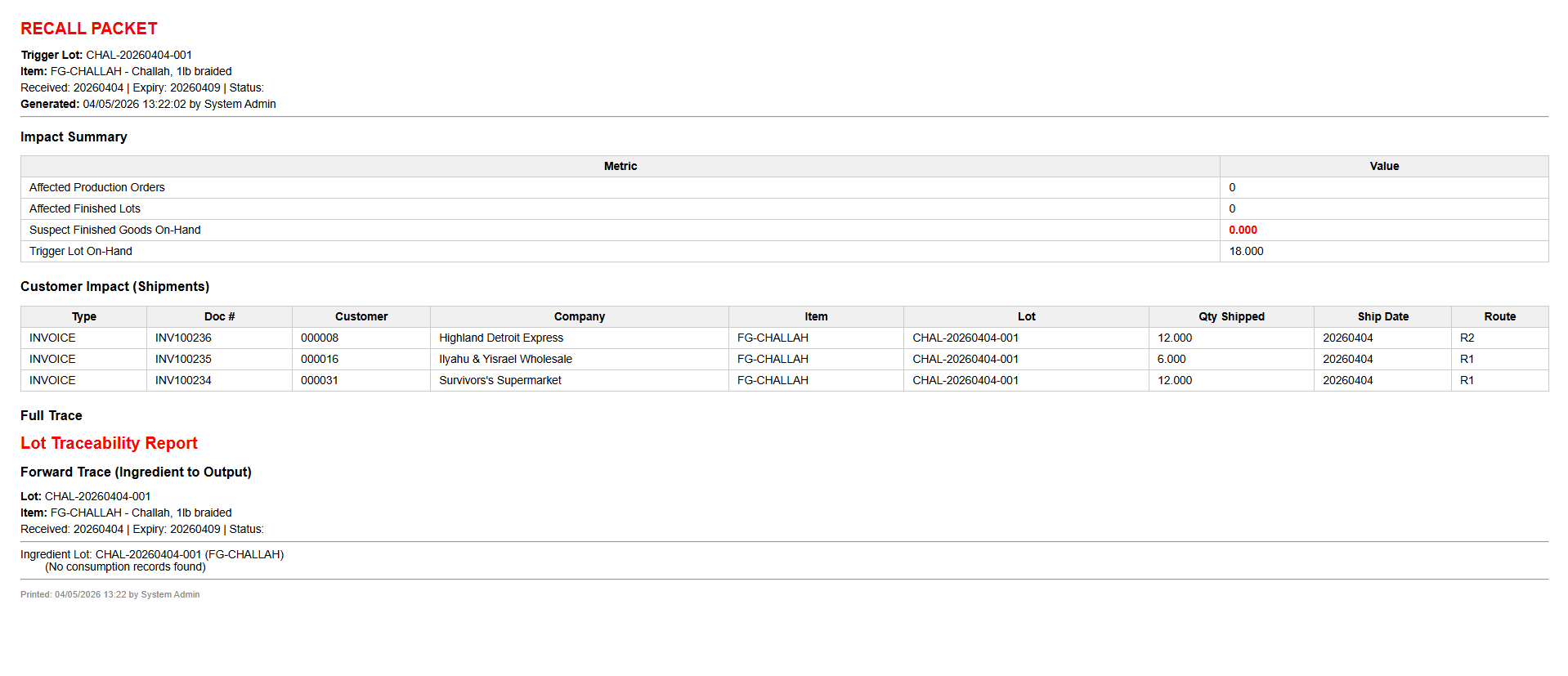
One-click recall packet with customer impact
Route delivery integration
Bakery production and bakery delivery are two halves of the same morning. Ask the Ledger connects them directly. Route customers are assigned to delivery routes with defined stop sequences. Recurring billing templates generate the standing orders that drive both the production plan and the route manifests.
When the production plan creates manufacturing orders for a given day, those orders reflect what the routes need. When the routes are generated, the system pulls the invoices for each customer and produces pick lists sorted by item for the warehouse, packing slips sorted by customer for the truck, and driver manifests sorted by stop order for the road. The driver, the packer, and the baker are all working from the same demand signal.
On-premise deployment
Bakeries start early and run on tight schedules. A cloud outage at 4 AM is not an inconvenience. It is a production shutdown. Ask the Ledger runs on your own server, on your own network. Your system is available when your building has power, regardless of your internet connection. Production data, customer records, recipe formulas, and lot histories stay on your hardware, under your backup policies, accessible to your team without routing through an external server.
For bakeries that operate multiple production shifts or start warehouse operations before dawn, this reliability is not a luxury. It is the baseline expectation for any system that sits at the center of a daily production and delivery workflow.
AI reporting examples
Bakery managers and owners need answers that reflect the dual nature of their operation: production and distribution. Ask the Ledger's AI reporting lets you ask questions in plain language and get actionable results. "Show me all ingredient lots expiring in the next 14 days," "What was the actual versus standard cost for all production orders last week," "Which route customers have had the most credits for stale returns this quarter," "List all batches that used flour lot 2026-03-15 and show who received the finished product." Results export to Excel for further analysis or regulatory submission.
Related reading: ERP for Food Distributors, Route Delivery Software, Recurring Billing ERP, and ERP Insights Blog.
Running a bakery means running a factory and a delivery fleet simultaneously, under time pressure, with perishable inputs and perishable outputs. The ERP system that serves this business cannot treat manufacturing and distribution as separate modules bolted together. It must understand that the production plan is driven by delivery demand, that lot traceability runs from the flour bin to the customer's receiving dock, and that every decision made before sunrise has a cost that shows up on the P&L before the end of the week. Ask the Ledger is built for bakeries that operate this way.
How Ask the Ledger compares for bakery operations
A head-to-head against the three ERPs bakeries most often evaluate alongside Ask the Ledger. Click any row heading for the detailed comparison.
| Criterion | Ask the Ledger | NetSuite | SAP Business One | Acumatica |
|---|---|---|---|---|
| Pricing model | One-time license + annual maintenance | Per-user per-month SaaS | Per-user annual license | Resource-based (users + modules) |
| Deployment | On-premise (Windows + PostgreSQL) | Cloud only | On-premise or cloud | On-premise or cloud |
| Recipes + BOM + production planning | Built into core, bakery-specific fields | Available via manufacturing module | Available via process manufacturing module | Available via manufacturing edition |
| FEFO + end-to-end lot traceability | Built into core inventory | Available via food/process add-on | Available via food/process add-on | Available via food/process add-on |
| Implementation footprint | Weeks for a single bakery | 4–6 months (typically multi-entity scope) | 4–6 months | 3–6 months |
Compare in depth: vs NetSuite · vs SAP Business One · vs Acumatica
Explore more resources
If you are evaluating distributor ERP options, these additional resources connect operational fit to financial planning and implementation reality. Start with the pages most relevant to your current questions and come back to the others as your process evolves.
- Compare us: vs NetSuite, vs SAP Business One, vs Acumatica, vs Sage 100, vs Dynamics 365 Business Central, vs Odoo, vs QuickBooks
- Financial guides: ERP total cost of ownership for distributors, how to calculate inventory turnover, AR collections best practices
- Operations guides: direct store delivery (DSD) software guide, warehouse management for small distributors, B2B ecommerce for wholesale distributors
- Implementation: ERP migration checklist, implementation guide, how to choose ERP for distributors
- Core pages: full feature list, on-premise ERP overview, route delivery software, recurring billing